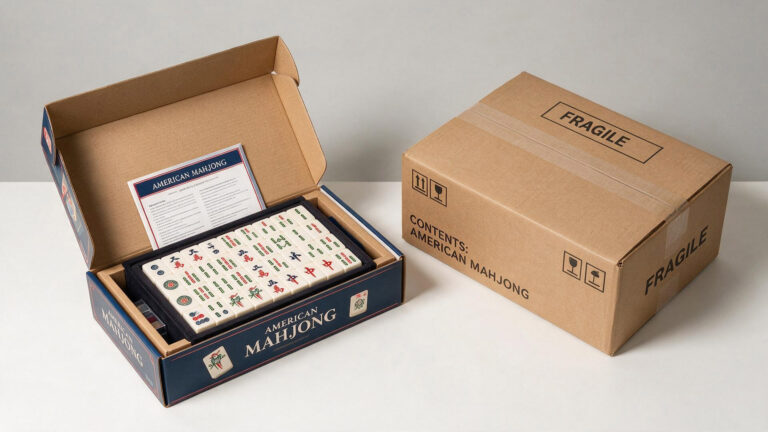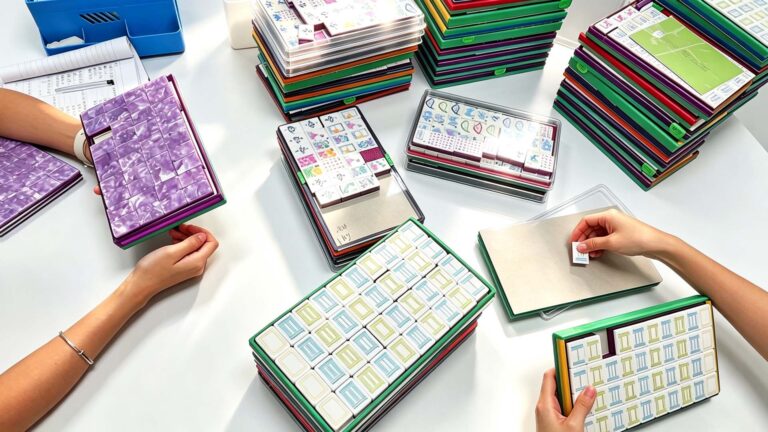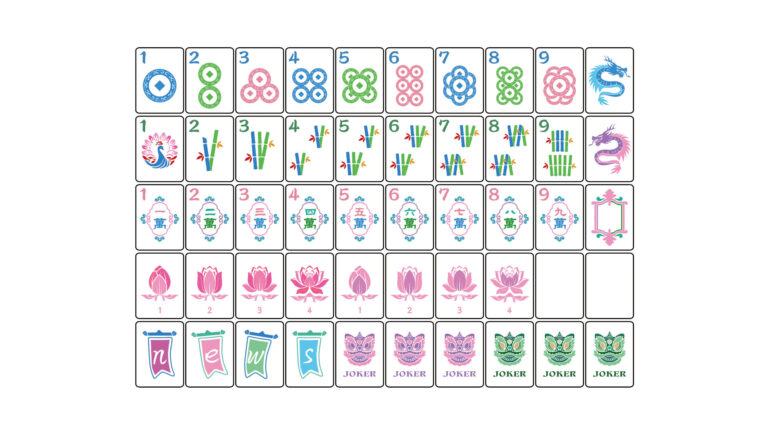

American Mahjong retailers rarely compete on tiles alone. A complete assortment can also include racks, pushers, mats, bags, dice, indicators, and other supporting items that make the game easier to carry, teach, display, and gift. The commercial opportunity is attractive, but it creates a sourcing challenge: every accessory must fit the intended set, customer, channel, and packaging plan.
For a wholesale buyer, the goal is not to add as many accessories as possible. It is to build a controlled range in which each item has a clear role, compatible dimensions, an approved quality standard, and a logical place in the retail offer. This guide explains how to plan wholesale American Mahjong accessories without relying on unverified assumptions about specifications, order quantities, or supplier capabilities.
Start With the Customer, Not the Accessory Catalog
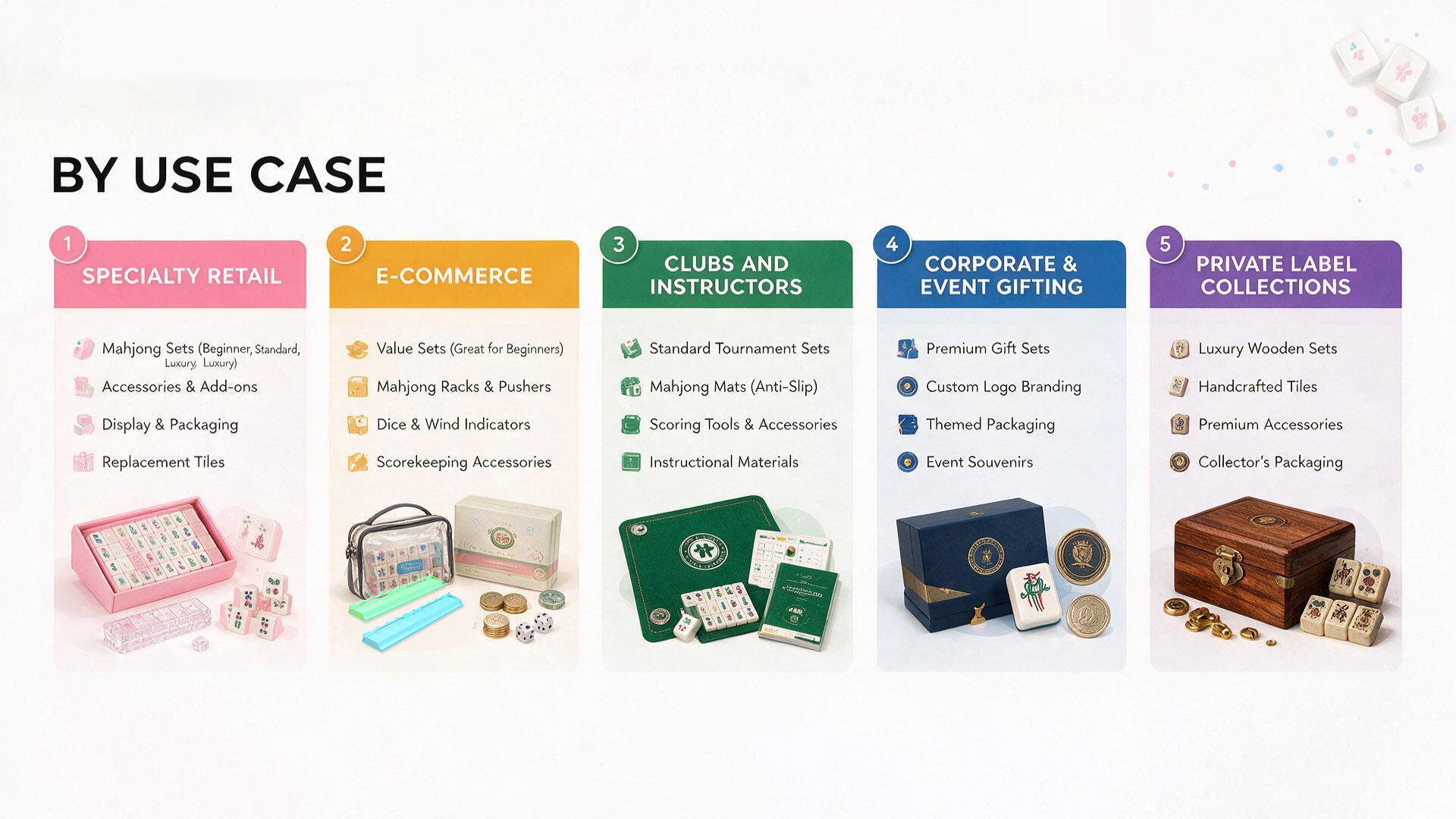
Two buyers can order the same accessory for very different reasons. A club may prioritize repeated setup and storage. A gift retailer may care more about presentation and coordinated colors. An online brand may need compact parcel dimensions, strong photography, and simple bundle choices. A teaching business may want equipment that helps new players organize tiles and follow play.
Before requesting quotations, define the primary customer and sales channel:
- Specialty retail: coordinated colors, shelf presentation, clear product naming, and giftability.
- E-commerce: parcel efficiency, protective packaging, accurate dimensions, and low-confusion bundle options.
- Clubs and instructors: repeated-use practicality, easy setup, replacement planning, and clear set compatibility.
- Corporate or event gifting: presentation, branding controls, packing accuracy, and delivery coordination.
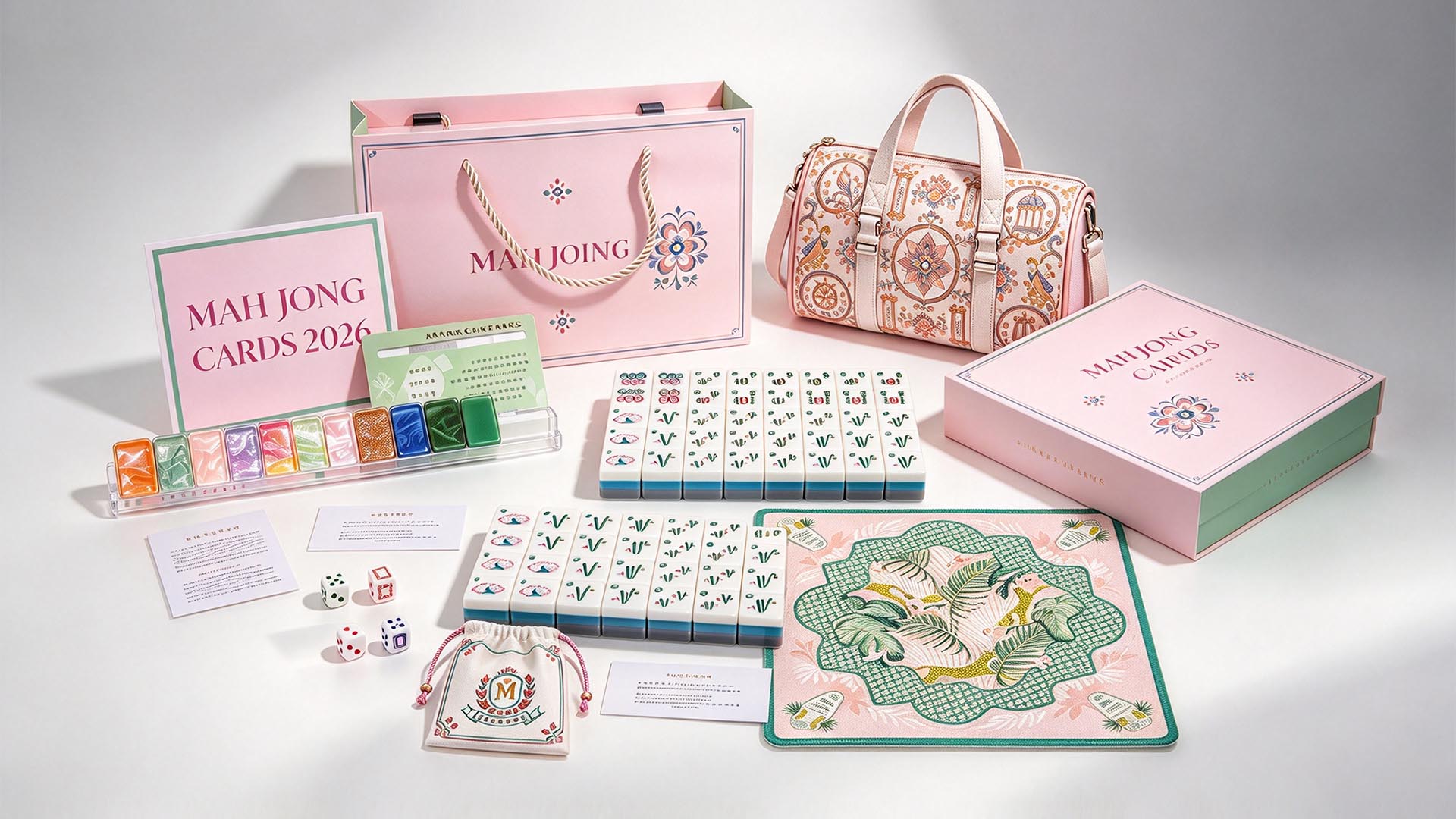
- Private label collections: consistent visual direction across the set, accessories, packaging, and product photography.
This customer-first step prevents a common buying mistake: selecting attractive products independently and discovering later that they do not work together as one assortment.
Build the Assortment in Three Layers
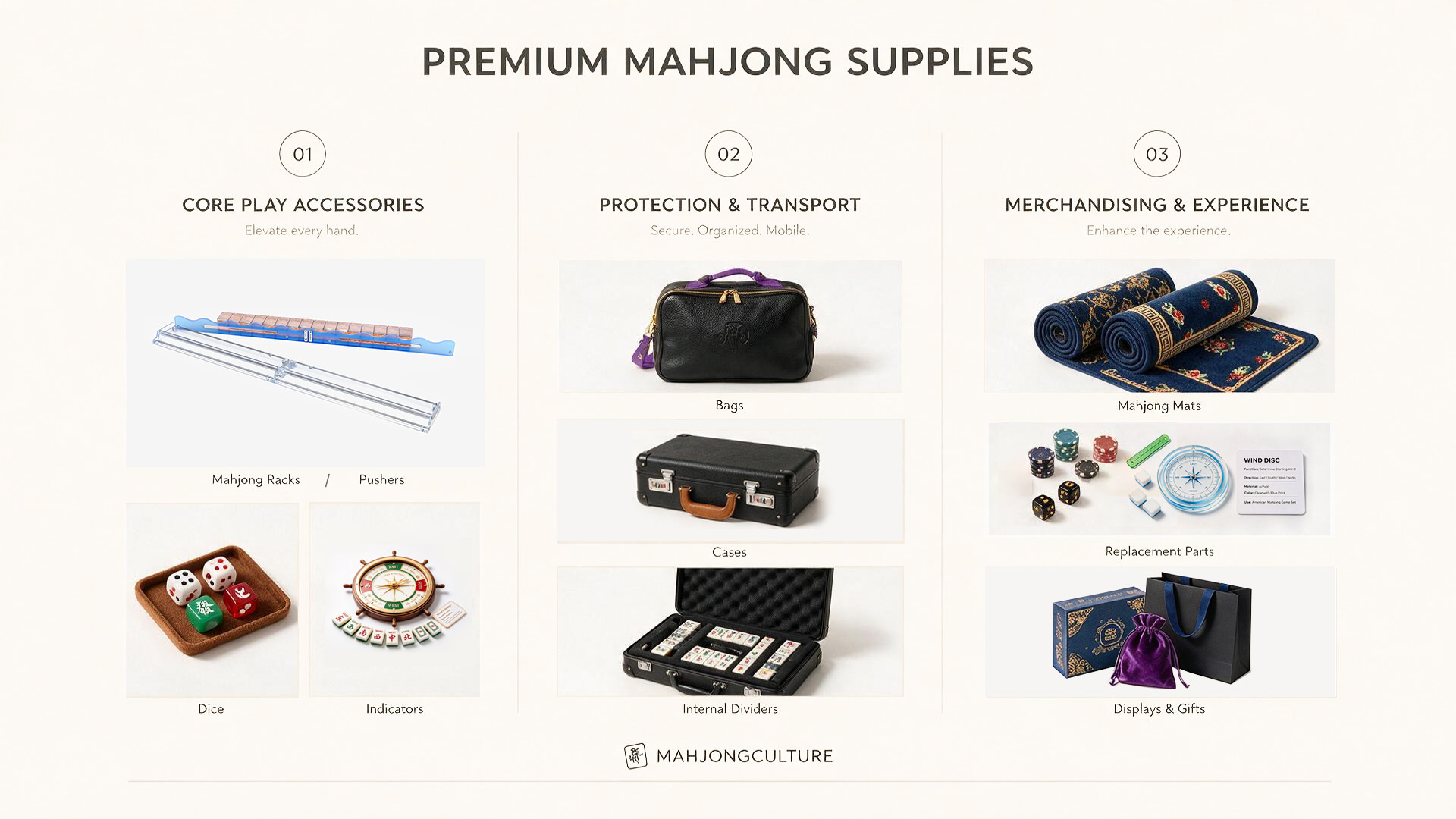
1. Core play accessories
Core accessories support the actual playing setup. Depending on the intended product configuration, these may include racks, pushers, dice, and indicators. Buyers should confirm which items are necessary for the experience they plan to sell and which are optional additions. Do not treat a component as standard simply because it appears in a competitor’s set.
Racks and pushers require especially careful compatibility review. The buyer should compare the sample against the intended tile dimensions, table setup, storage format, and user experience. TOPRAY’s foldable American Mahjong rack and pusher provides a current 2-in-1 product reference, but final compatibility should be confirmed with the actual tile and packaging samples.
2. Protection and transport accessories
Bags, cases, and internal organizers protect the product between games and make storage easier. Their value depends on fit rather than appearance alone. A bag should be evaluated with the complete approved contents inside it—not with an empty shell or a different set.
Check how tiles, racks, pushers, dice, and printed materials are separated. Look for concentrated pressure points, movement during handling, contact between hard parts, closure stress, and the amount of unused space. The accessory bags category shows the relevant product area, while the final purchase brief should identify the precise contents the bag must hold.
3. Merchandising and experience accessories
Mats, coordinated storage pieces, replacement components, and presentation items can help retailers create bundles or add-on sales. These products should solve a visible customer task: protecting a table, organizing play, carrying a set, replacing a lost component, or creating a gift-ready package.
Create a Compatibility Matrix Before Sampling
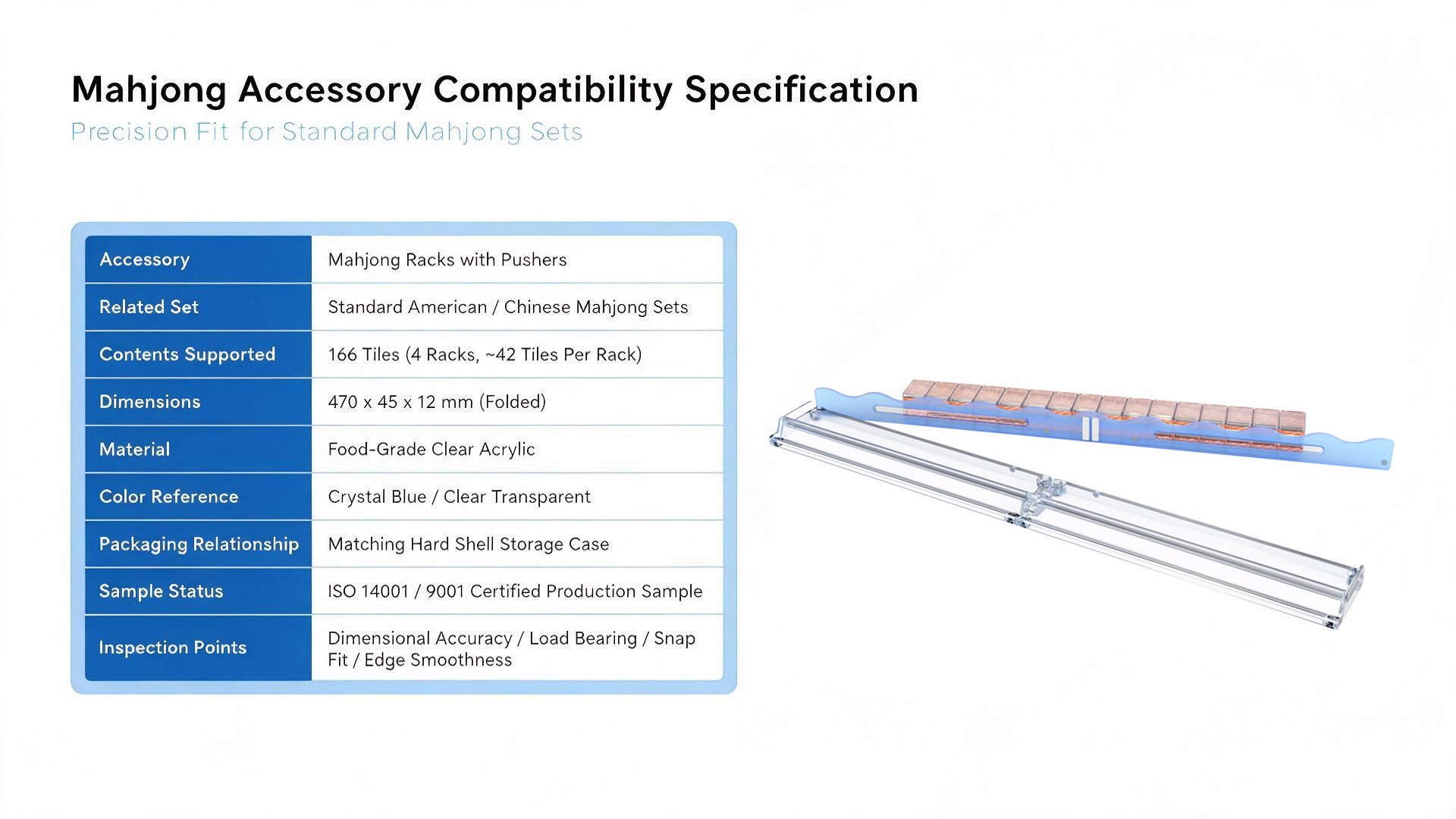
“Compatible with American Mahjong” is too broad for a purchase order. Accessories interact with tile size, tile count, rack geometry, packaging cavities, and the buyer’s chosen set configuration. A compatibility matrix turns those relationships into an approval document.
For each accessory, record:
- the related tile or set reference;
- the contents it must hold or support;
- critical internal and external dimensions;
- material and finish expectations;
- color reference and approved tolerance method;
- branding location and artwork version;
- retail unit and master-carton relationship;
- sample approval status;
- inspection points and acceptable variation;
- replacement or replenishment role, if applicable.
Dimensions do not replace a physical fit test. A rack can meet a nominal requirement and still feel unstable with a particular tile. Approve related components together whenever possible.
Decide What Will Be Sold Separately and What Will Be Bundled
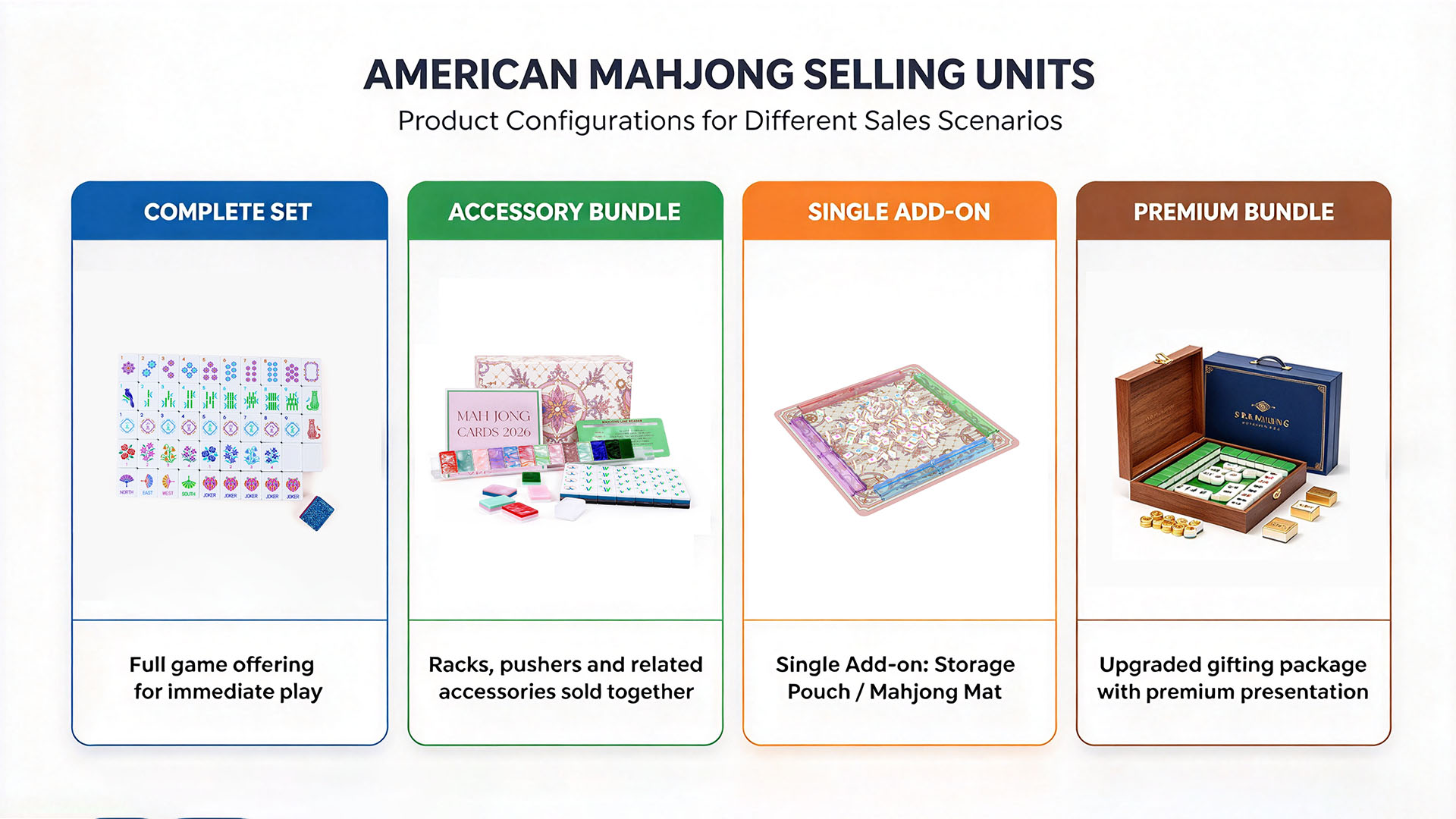
The same accessory may need different packaging, labeling, and inventory treatment depending on whether it is sold alone or packed inside a complete set. Decide this before quotation because the decision affects inserts, barcodes, carton quantities, product photography, and receiving.
A simple assortment architecture can include:
- Complete set: the approved tile configuration plus defined included components.
- Accessory bundle: a coordinated group such as racks and pushers or a storage-focused kit.
- Single add-on: an individually packaged mat, bag, or replacement component.
- Premium bundle: a complete set combined with selected accessories and upgraded presentation.
Write a separate bill of contents for every sellable unit. If one accessory is optional, mark it optional in the quotation and packaging brief. This protects both the buyer and supplier from assuming that a photographed item is included.
Approve Color and Branding as a Coordinated System
A coordinated collection can fail visually even when every item looks acceptable on its own. Different materials reflect light differently, and the same digital color value will not necessarily appear identical on acrylic, fabric, coated paper, or printed packaging.
Give the supplier a hierarchy of color controls. Specify which sample is the master reference, which components should match closely, and where a complementary rather than identical color is acceptable. Review samples under consistent lighting and photograph the approved group together.
For private label work, keep one controlled artwork package with filenames, revision dates, logo placement, print method, and approval status. Do not reproduce third-party logos, patterns, rule cards, or other protected content without permission. The USPTO trademark basics page is a useful starting point for understanding U.S. trademark concepts, but buyers should obtain appropriate professional advice for their own artwork and brand use.
Use a Sample Plan That Tests the Whole Retail Offer
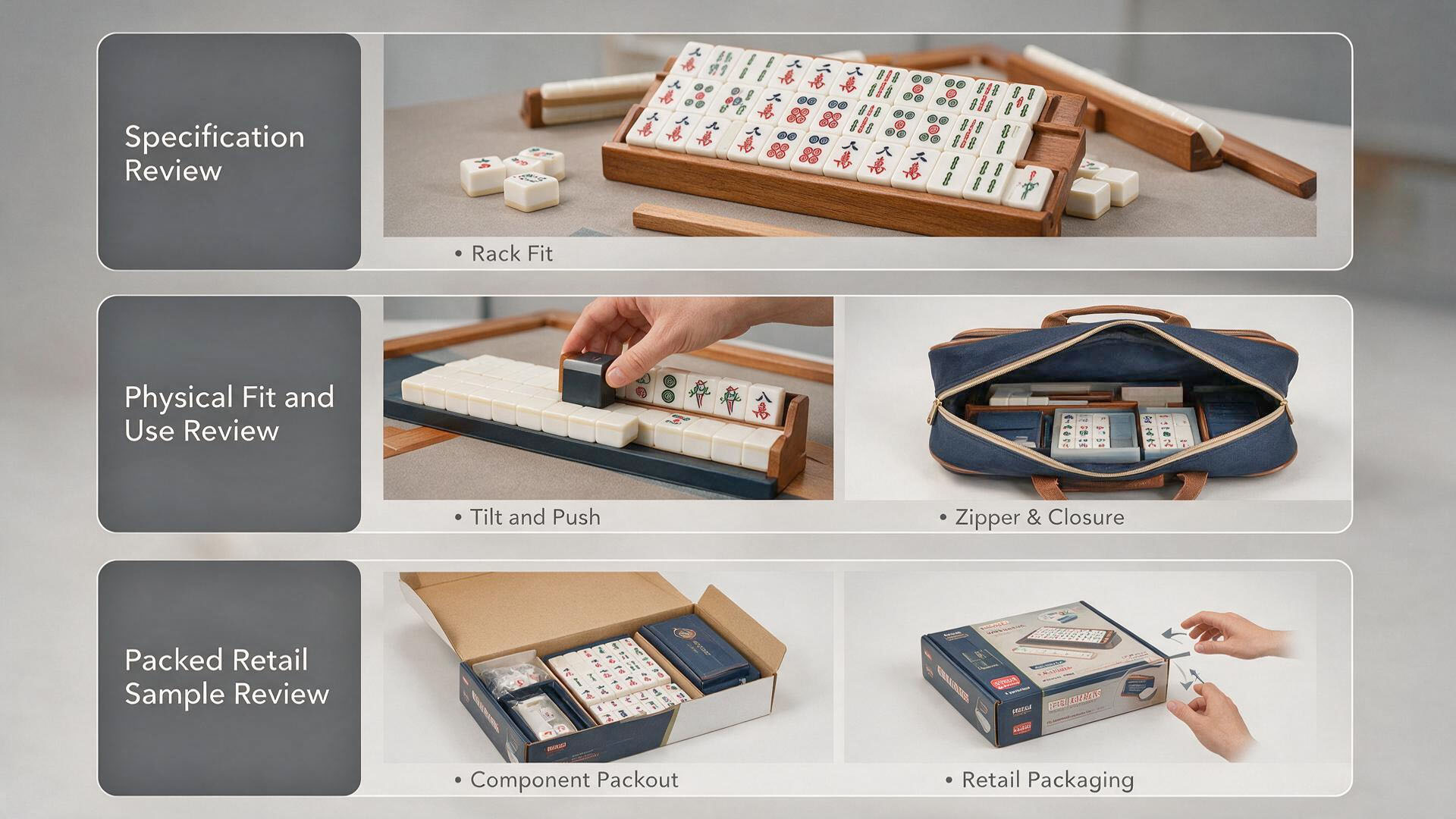
An accessory sample should answer a decision, not merely show that an item exists. Organize approval in three stages:
Specification review
Confirm the accessory list, intended set reference, dimensions, materials, colors, branding, packaging role, and inspection points.
Physical fit and use review
Test the accessory with the real components it will support. Open and close the bag, place the tiles on the racks, move the pushers through the intended setup, and pack every component into its assigned position. Document wobble, tightness, movement, surface contact, and any mismatch between renderings and physical results.
Packed retail sample review
Approve the item in the form customers and warehouses will receive. Check the bill of contents, labeling, protective materials, presentation, barcode placement, and carton marks. For detailed tile checks, use TOPRAY’s acrylic Mahjong tile inspection guide alongside the accessory checklist.
Define Quality Checks by Accessory Type
A single instruction such as “good quality” is not auditable. Translate expectations into visible and measurable checks.
- Racks and pushers: straightness, stable placement, edge finish, connection quality, surface consistency, and fit with the approved tile.
- Bags and cases: usable internal space, seams, handles, closures, lining, odor, surface cleanliness, and packed-product movement.
- Mats: dimensions, edge treatment, print alignment, surface condition, color consistency, rolling or folding behavior, and packaging method.
- Dice and small components: count, appearance, print clarity, dimensional consistency, and secure packing.
- Printed inserts: correct version, readable text, artwork approval, language, quantity, and placement.
The checklist should distinguish a functional failure from a minor cosmetic variation. Define how many samples will be reviewed, where measurements will be taken, and which approved sample or document controls the decision.
Plan U.S. Product Claims and Safety Responsibilities Early
Retailers, importers, distributors, and manufacturers can have responsibilities related to consumer product safety. The CPSC Business Education library helps businesses identify guidance by product type and business role. Product classification, intended age group, materials, construction, and marketing claims can affect which requirements apply, so compliance should be reviewed for the actual item and market rather than copied from another product.
Marketing language also requires discipline. The FTC’s advertising guidance states that advertising claims must be truthful, not deceptive or unfair, and supported by evidence. Avoid unsupported claims such as “scratch-proof,” “non-toxic,” “eco-friendly,” or a country-of-origin statement unless the business has the evidence and review needed for that exact claim.
This section is operational guidance, not legal advice. Buyers should involve their compliance professionals before finalizing claims, age grading, warnings, test plans, and labels.
Send a Quote-Ready RFQ
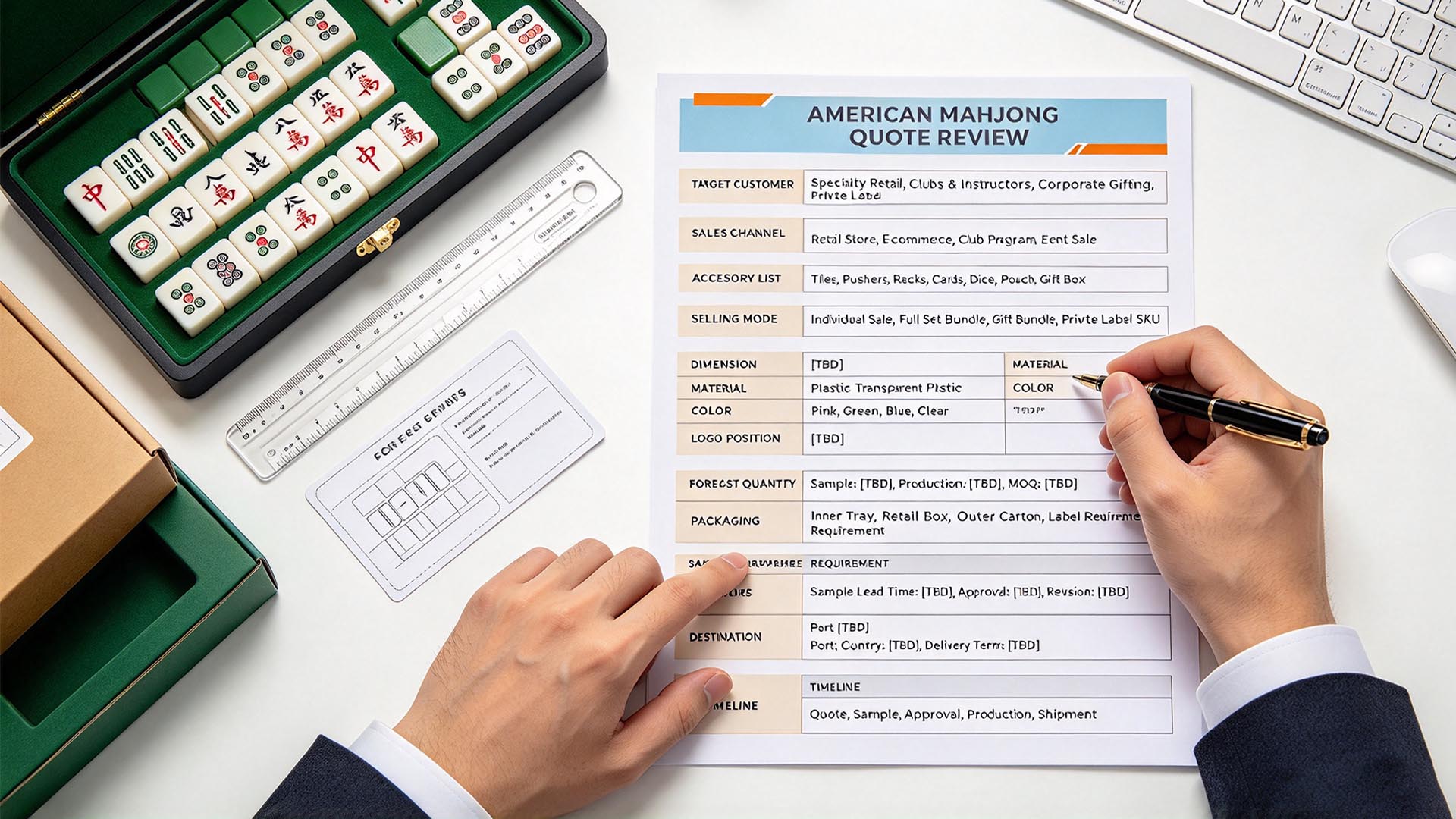
A strong request for quotation lets suppliers price the same scope. Include:
- target customer, sales channel, and destination market;
- the complete set and accessory list;
- which items are included, optional, or sold separately;
- reference photos or drawings that you have the right to use;
- dimensions, materials, colors, finishes, and branding requirements;
- estimated quantity by SKU, color, and bundle;
- packaging structure and retail labeling needs;
- sample stages and approval criteria;
- required documents or testing questions for your market;
- target timeline, shipping destination, and quotation format.
If the specification is still open, ask the supplier to label every assumption and option. This makes comparisons more reliable than accepting one total price built on an unclear product configuration.
Frequently Asked Questions
Which American Mahjong accessories should a retailer start with?
Start with items tied to a clear customer task and to the sets already planned for sale. Racks and pushers, storage, and selected table-use accessories are common areas to evaluate, but the right opening range depends on channel, customer, price architecture, and compatibility.
Can accessories from different suppliers be combined?
They can be, but the buyer must own compatibility control. Test the actual components together, document dimensions and color references, and approve the complete packed configuration rather than relying on catalog descriptions.
Should accessories use the same color as the tiles?
Not necessarily. Different materials can make an exact visual match difficult. Decide whether the design requires a close match, a coordinated contrast, or a neutral supporting color, then approve physical samples as a group.
What should be checked before approving an accessory sample?
Confirm fit, function, finish, color, branding, packed contents, labeling, and the relationship to the approved set. Record the result in a signed or otherwise controlled approval document.
How should buyers request wholesale pricing?
Provide the product list, configuration, estimated quantity by SKU, customization scope, packaging, destination, and sample requirements. A complete RFQ reduces assumptions and makes supplier proposals easier to compare.
Build a Coordinated Accessory Program With TOPRAY
TOPRAY works with business buyers developing wholesale, custom, and private label American Mahjong products. To request a feasibility review, share your target customer, set configuration, accessory list, reference materials, estimated quantities, packaging direction, and destination market.
Explore the TOPRAY product range, review the wholesale American Mahjong page, or contact TOPRAY with a quote-ready accessory brief. Available options, quantities, timing, and documentation should be confirmed for the specific project.