
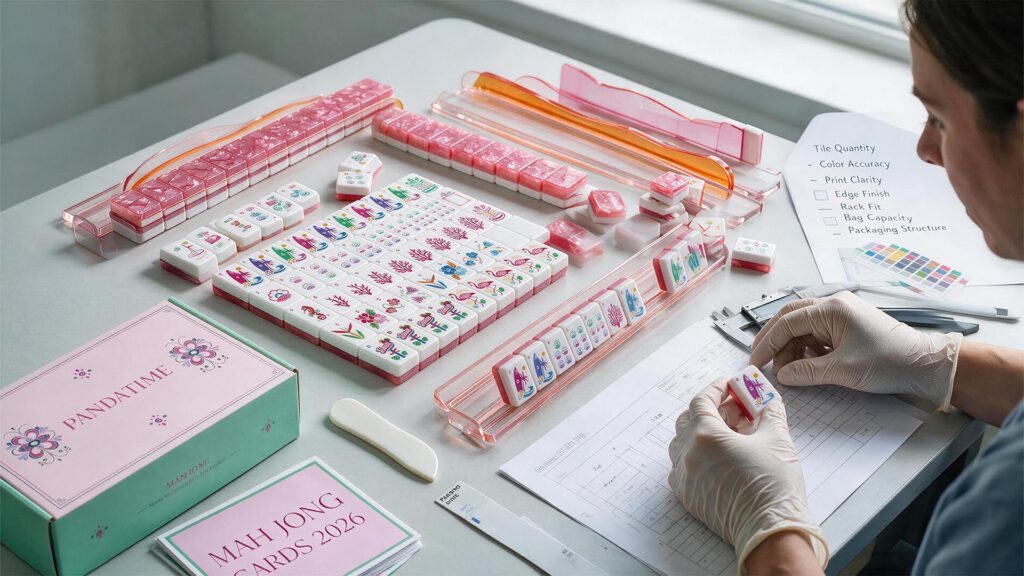
Acrylic Mahjong tiles can look nearly identical in supplier photos, yet important quality differences often become obvious only when you inspect the material, dimensions, edge finish, printing, color, set configuration, and packaging. Those differences matter even more in a bulk order, where a small recurring defect can affect hundreds of retail units.
A pre-production sample confirms direction; it does not prove that every mass-produced set will match. Buyers sourcing wholesale American Mahjong sets need written specifications, an approved reference sample, and a repeatable Mahjong tile inspection plan before authorizing shipment.
Why Inspection Matters for Acrylic Mahjong Bulk Orders
A retail customer can exchange one defective set, but a wholesale buyer may find the same issue across an entire shipment. Scratches, uneven tile heights, shifted artwork, missing Jokers, or damaged boxes can cause returns, negative reviews, and repacking costs.
For private-label buyers, consistency matters more than one perfect show sample. Agree on defect definitions, tolerances, sampling, and acceptance criteria before production. For formal lot-by-lot inspection, buyers may specify an acceptance-sampling framework such as ISO 2859-1:2026 instead of an undefined ‘random check.’
1. Check the Acrylic Material Quality First
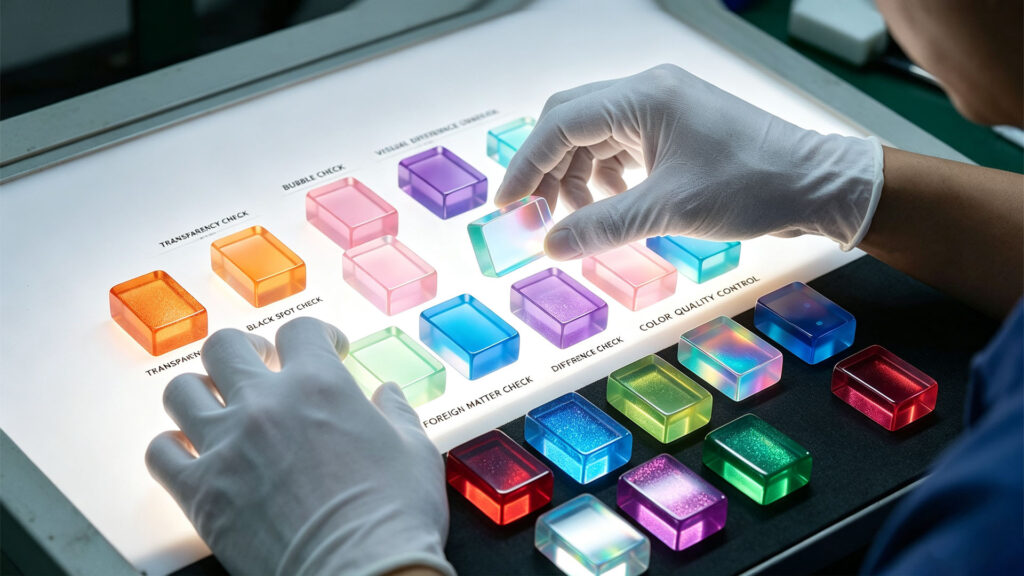
Inspect tiles under neutral lighting and against light and dark backgrounds. Clear acrylic should not look cloudy, yellow, or gray. Colored material should be free from unexpected streaks, black dots, bubbles, inclusions, and obvious shade variation. Check both the face and edge.
Transparent, pastel, pearlescent, gradient, and laminated designs deserve extra attention, especially when developing custom Acrylic Mahjong tiles. Approve physical swatches or material-effect samples, not only a screen rendering. Pantone’s color-system guidance distinguishes physical and digital color tools because on-screen simulations may not match physical standards.
2. Inspect Tile Size, Thickness, Weight, and Flatness
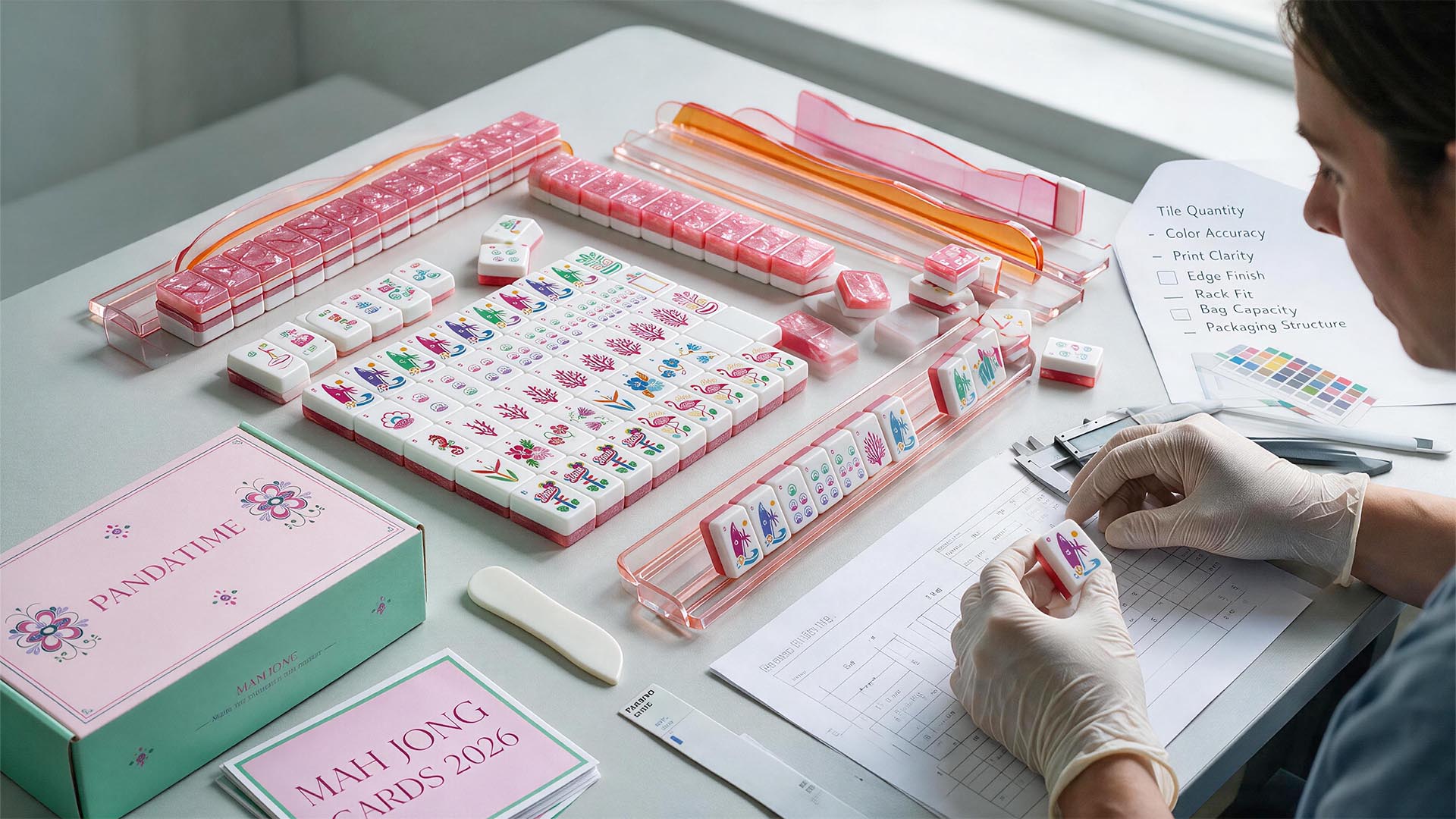
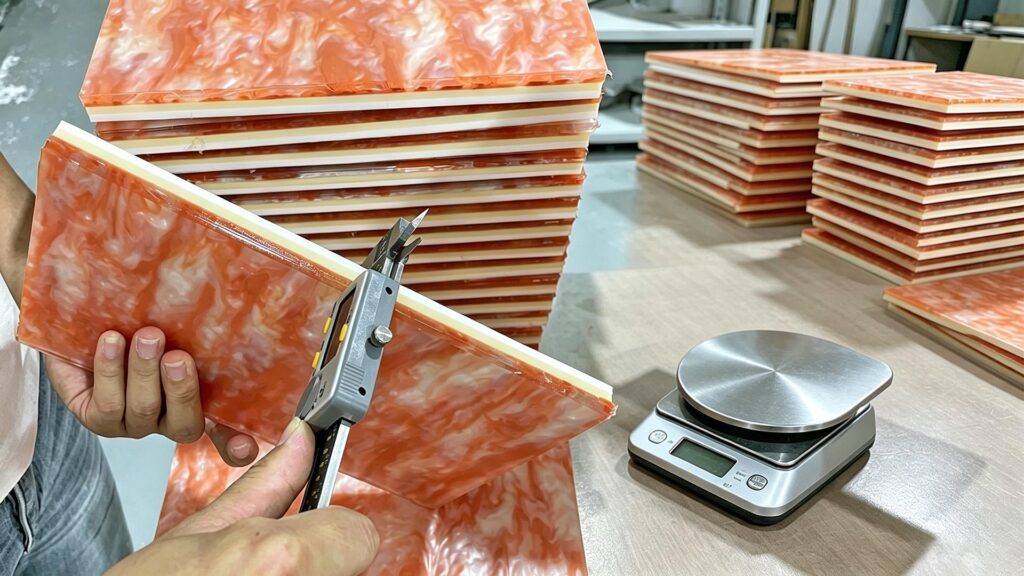
Use a calibrated caliper to measure tiles from different sets and cartons, and a scale for weight checks. Record results. Tolerances should come from the signed specification because acceptable variation depends on tile format, construction, racks, and packaging.
| Check Point | Practical Method | Why It Matters |
| Size consistency | Measure tiles from multiple sets and cartons. | Supports neat stacking, wall building, and a professional appearance. |
| Thickness | Compare face-to-back measurements with the approved range. | Affects hand feel, rack fit, and tray compatibility. |
| Weight | Weigh individual tiles and compare unusual outliers. | Influences shuffling feel and perceived quality. |
| Flatness | Place tiles on a level surface and look for rocking or gaps. | Improves stability during play and storage. |
Finally, line up a complete group of tiles in racks and build a wall. Noticeable height differences, rocking, or uneven rows reveal problems that isolated measurements can miss.
3. Look Closely at Edge Grinding and Polishing
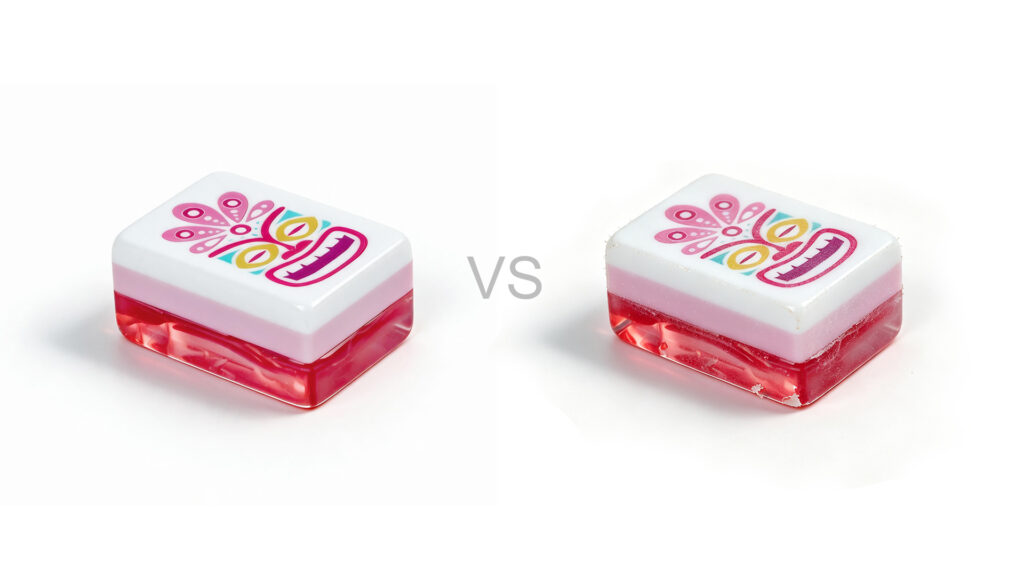
Run a clean fingertip carefully along every side and corner. Edges should feel smooth and comfortable, with no burrs, sharp points, cutting marks, chips, or hairline cracks. The polish should be even on all sides. On transparent tiles, finished edges should look clean and bright rather than rough or milky. On multi-layer tiles, layers should remain neatly aligned without visible separation or glue residue.
Edge quality reflects cutting, grinding, polishing, cleaning, and handling. PLEXIGLAS processing guidance explains that sanding followed by polishing restores a glossy transparent surface to rough-cut edges. On Mahjong tiles, this directly affects appearance and hand feel.
4. Check Printing Clarity, Readability, and Alignment
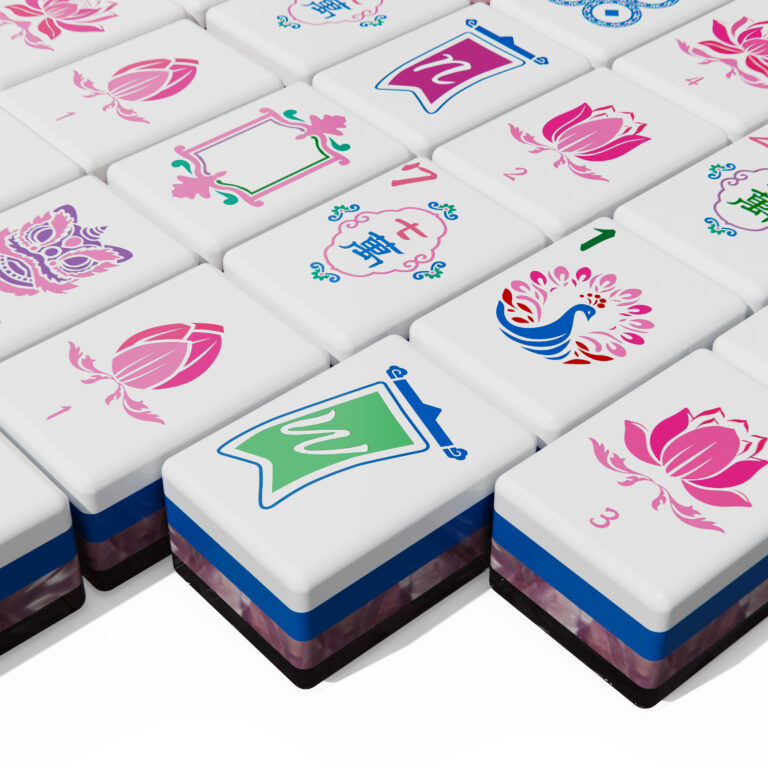
Inspect Dots, Bams, Craks, Winds, Dragons, Flowers, and Jokers at normal playing distance as well as close up. Characters and fine lines should be sharp, readable, and consistently centered. Compare multiple copies of the same tile for ghosting, blurred details, missing print, registration shifts, and inconsistent saturation.
Compare production colors with the signed-off sample under the same lighting. Creative artwork must preserve fast recognition of suits and values during real play.
5. Evaluate Color Matching Across the Full Set
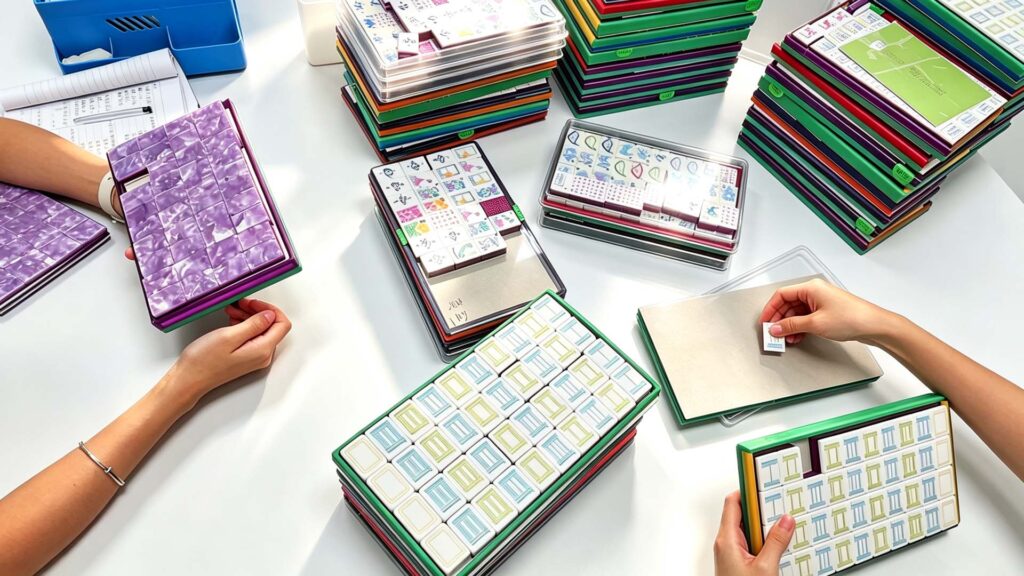
Check back colors across the entire set and between randomly selected boxes. Small shade differences can become obvious when tiles are arranged together. For custom projects, compare tiles with approved physical swatches or a signed master sample. Document lighting conditions where color accuracy is especially important.
Evaluate the tiles, accessories, inserts, and gift box together. Colors need not be identical, but they must follow the approved palette. Pastels, gradients, and layered constructions are especially sensitive to material lot and viewing background.
6. Test Surface Finish and Scratch Condition
Tilt each tile under directional light to reveal scratches, haze, fingerprints, stains, white marks, black dots, adhesive, or polishing residue. Glossy surfaces should have consistent reflectivity; matte surfaces should look even rather than patchy. Shuffle a sample group, slide it across the approved mat, and clean it using the supplier’s recommended method to assess feel and normal handling.
Do not improvise aggressive chemical tests. Acrylic cleaning guidance warns that unsuitable cleaners and abrasive action can damage the surface. Define cleaning and durability procedures in advance.
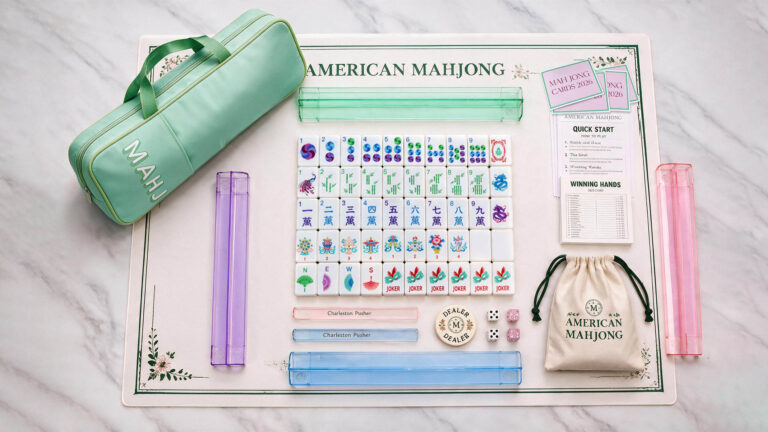
7. Confirm Tile Count and American Mahjong Configuration
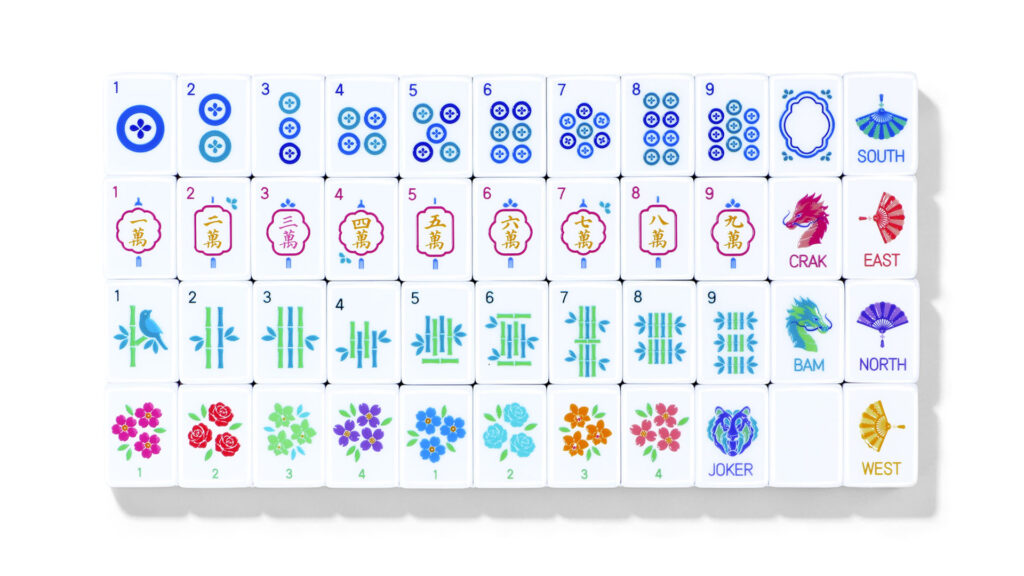
A missing, duplicated, or incorrect tile is a critical functional failure. Do not assume every American Mahjong set uses one universal count: configurations can differ by brand, spare tiles, and included extras. Inspect against the approved bill of materials (BOM), artwork list, and packing specification.
- Verify every suit sequence and the required Winds and Dragons.
- Confirm the agreed numbers of Flowers, Jokers, blanks, and spare tiles.
- Check that artwork matches the correct tile identity and orientation.
- Confirm any scorecard, instruction card, spare-piece list, or replacement policy insert.
Treat the set as a complete playing system. A visually perfect tile is irrelevant if the box cannot support a full game.
8. Inspect Racks, Pushers, Dice, Mats, and Bags
Test accessories with the tiles. Racks should fit the approved dimensions, and pushers should move smoothly without excessive flex or rough edges. Confirm dice quantity and legibility. Mats should lie flat with clean printing and no strong unwanted odor. Test bag zippers, handles, and fasteners.
Every box must contain the same accessories. Separators, sleeves, or protective films should stop components rubbing against acrylic in transit. Buyers can review the TOPRAY American Mahjong product collection when planning tile and accessory combinations. Gift channels prioritize appearance; clubs need durability; e-commerce requires scratch-free arrival.
9. Review Retail and Shipping Packaging
Check gift boxes for dents, scuffs, weak corners, and color variation. Inner trays should secure the tiles without pressure marks, while heavy components should be separated. Verify logos, barcodes, required labels, instructions, and carton markings against approved files.
Run agreed packaging checks using the packed product. Shake, drop, or compression protocols can expose weak trays and cartons. Define methods, sample quantities, and pass/fail criteria in advance. Packaging is both a sales surface and a protection system.
Sample Approval vs. Bulk Inspection
| Stage | Main Focus |
| Sample approval | Design, material effect, color direction, structure, accessories, and packaging concept |
| Pre-production check | Final artwork, physical color references, dimensions, tolerances, BOM, process, and quantity |
| Bulk inspection | Consistency, defects, printing, polishing, configuration, accessories, and retail packing |
| Final shipment check | Carton quantities, labels, shipping marks, condition, and transport protection |
Date and identify the approved sample, retaining one with each party when practical. Replace terms such as ‘premium polish’ or ‘close color’ with measurable requirements, references, defect categories, and a sampling plan.
Define Defects Before Inspection
The buyer and supplier should approve defect definitions and acceptance rules before production. The examples below are classifications, not universal AQL limits.
| Defect Level | Examples | Typical Decision |
| Critical | Wrong tile configuration, unsafe sharp edge, or incorrect required labeling | Hold or reject the affected shipment according to the agreed standard |
| Major | Missing accessory, blurred print, visible color mismatch, or damaged retail box | Compare the sample count with the agreed acceptance criteria |
| Minor | Small cosmetic mark that does not affect play, identification, or retail presentation | Record and evaluate within the approved tolerance |
Approve a Golden Sample Before Production
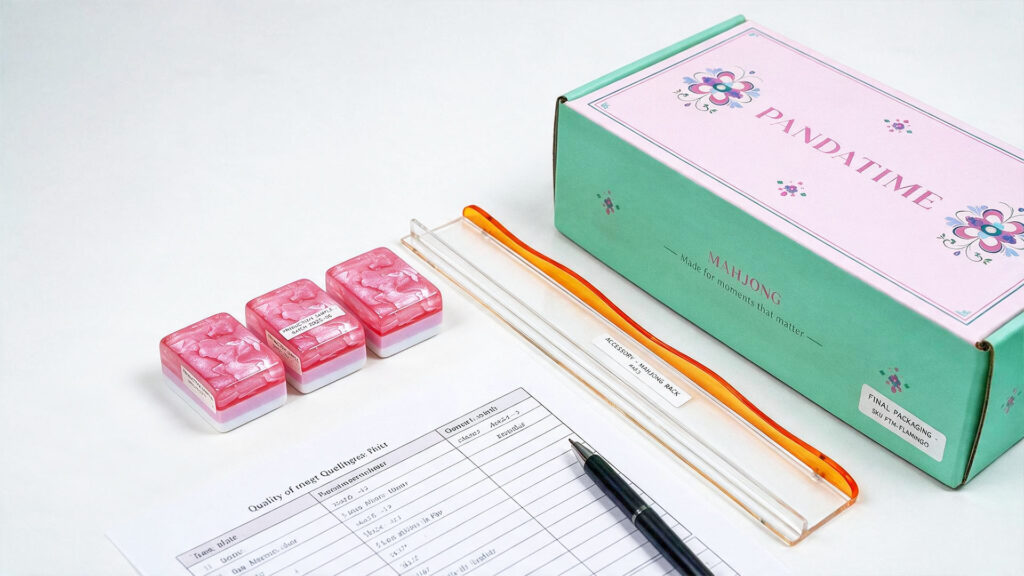
- A dated golden sample gives both parties the same physical reference for bulk quality control.
- Confirm final artwork, tile-by-tile content, BOM, dimensions, tolerances, and packaging specification.
- Approve the physical acrylic construction, color reference, surface finish, and printed result.
- Test the sample with the approved racks, tray, bag, and retail packaging.
- Identify and retain the approved sample, then record any permitted deviations in writing.
- Use the same sample and specification during bulk inspection and final shipment approval.
A Practical Acrylic Mahjong Inspection Checklist
- Material clarity and approved color; no unacceptable bubbles, dots, haze, or inclusions
- Tile length, width, thickness, weight, and flatness within agreed tolerances
- Smooth, evenly polished edges with no chips, cracks, burrs, or layer separation
- Sharp, centered, complete printing with playable artwork and stable saturation
- Scratch-free faces and consistent glossy or matte finish
- Complete tile count and correct approved American Mahjong configuration
- Matching, functional racks, pushers, dice, mats, bags, and other accessories
- Secure retail packaging, correct inserts, labels, barcodes, and master cartons
- Inspection records linked to the purchase order, lot, carton sample, and approved standard
What to Ask Your Supplier Before Confirming a Bulk Order
- Can you provide a pre-production sample and physical material or color references?
- Which acrylic constructions and surface finishes are available for this design?
- What dimensional tolerances and defect standards can you commit to?
- How do you control artwork registration, print color, polishing, and batch consistency?
- Can you coordinate tiles with racks, pushers, mats, bags, and private-label packaging?
- What inspection method, sampling plan, reports, and packaging tests will be used?
- What specifications, artwork files, quantities, and destination requirements are needed for an accurate quotation?
Final Thoughts
A high-quality Acrylic Mahjong set is not defined by color alone. Successful bulk orders depend on stable material, consistent dimensions, comfortable edges, readable printing, controlled color, complete configuration, functional accessories, protective packaging, and repeatable production.
Define quality before releasing the purchase order. Establish a signed specification, approved sample, BOM, defect classification, inspection plan, and packaging standard, then use them through production and final inspection.
If you are planning a wholesale or custom Acrylic Mahjong order, learn more about TOPRAY’s American Mahjong supply capabilities. To begin a project review, send TOPRAY your requirements, including design files, target quantity, set configuration, packaging needs, destination market, and requested delivery date.
Frequently Asked Questions
What should I check before ordering Acrylic Mahjong tiles in bulk?
Check material clarity and color, dimensions, weight, flatness, edge polishing, print quality, surface condition, tile configuration, accessories, retail packaging, and shipping cartons against approved specifications.
Why is acrylic material quality important for Mahjong tiles?
Clarity, color, inclusions, surface condition, and edge appearance directly affect perceived value, play experience, and the consistency customers see when a full set is arranged.
How can I check printing quality on Mahjong tiles?
Compare production tiles with approved artwork and a signed sample. Inspect sharpness, alignment, readability, saturation, ghosting, missing print, blurred details, and consistency among repeated tiles.
Should I inspect accessories together with the tiles?
Yes. Racks, pushers, dice, mats, bags, inserts, and packaging form one retail product. A correct tile set can still fail if accessories are missing, incompatible, damaged, or poorly packed.
Is sample approval enough before a bulk Mahjong order?
No. Sample approval confirms the intended design and construction. Bulk inspection verifies consistency, quantity, defect control, configuration, accessory matching, packaging, and shipment condition across the production lot.