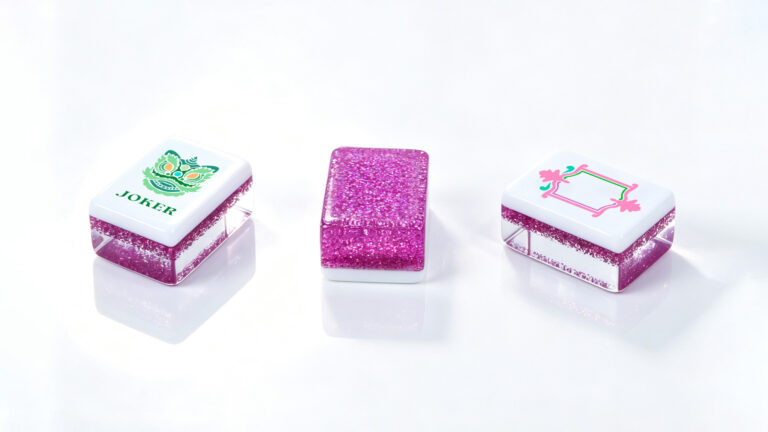
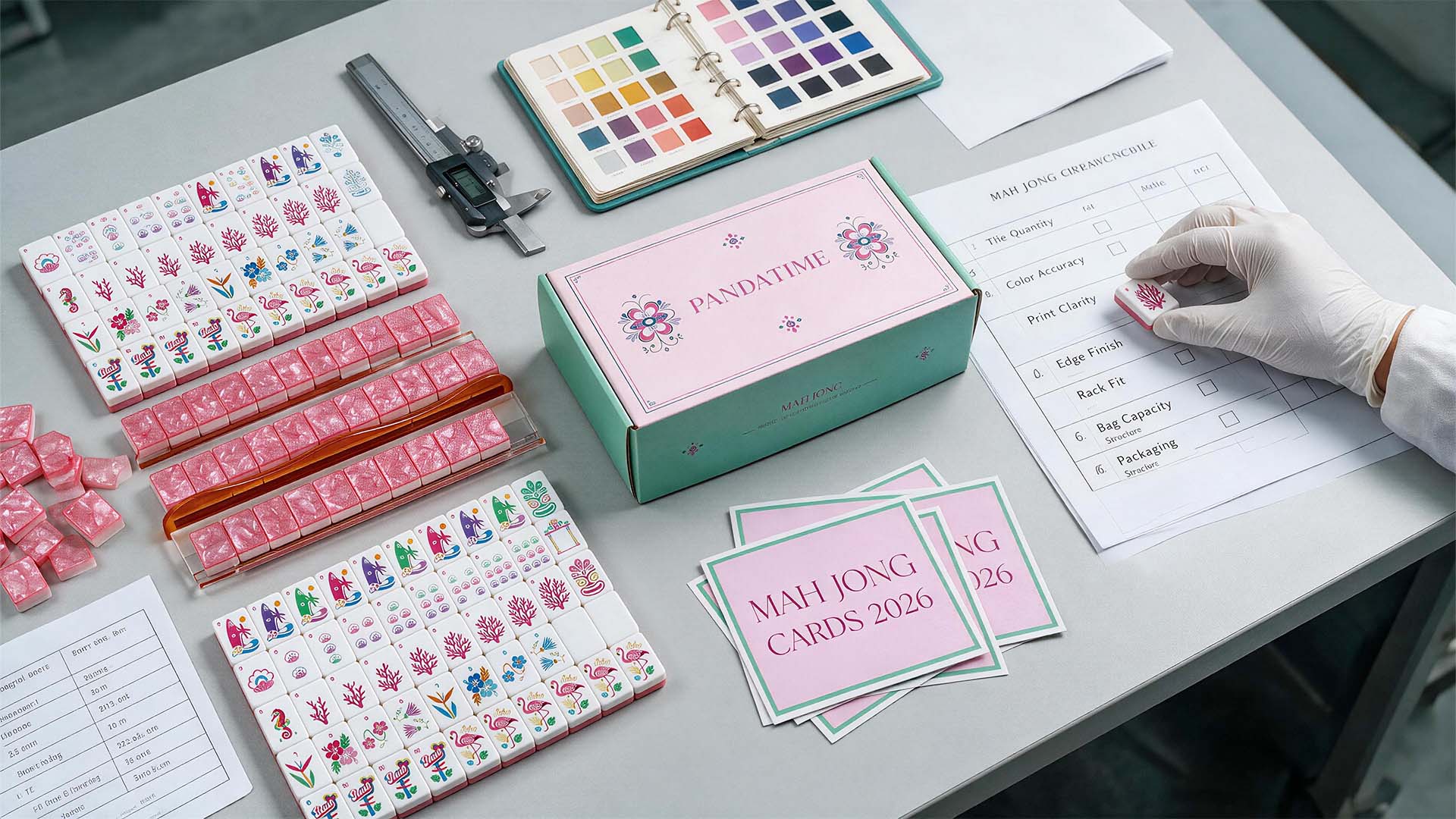

Creating a custom American Mahjong set involves much more than choosing colors and placing artwork on tiles. A successful product must combine correct tile configuration, readable graphics, suitable materials, compatible accessories, retail-ready packaging, and production standards that can be repeated across an entire order.
For brands, retailers, and distributors, the most important decisions are often made before mass production begins. Tile dimensions affect rack compatibility. Artwork affects gameplay readability. Packaging affects shipping protection and retail positioning. Even a small change to the tile structure may influence weight, cost, sampling, and lead time.
A successful custom American Mahjong set starts long before the factory begins production. This guide explains the main stages of product development and what brands should prepare before requesting a quote or approving a sample.
What Can Be Customized in an American Mahjong Set?
Most parts of an American Mahjong set can be customized, but each option has different technical and commercial implications.
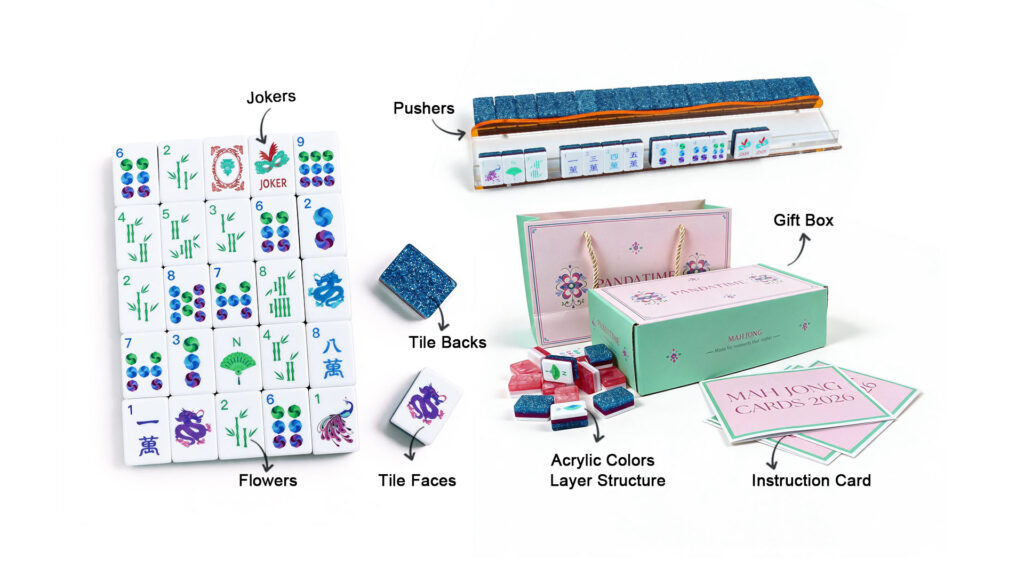
Common customization areas include:
- Tile colors and transparency
- Tile faces and symbols
- Joker and flower designs
- Tile backs
- Brand logos
- Acrylic layer structures
- Glitter, pearl, translucent, or solid-color effects
- Racks and pushers
- Carrying bags
- Playing mats
- Dice and accessories
- Gift boxes
- Instruction cards
- Barcode and retail labels
- Outer-carton markings
Some projects require only a logo and packaging update. Others involve a completely new tile collection, custom joker artwork, coordinated accessories, and a new box structure.
Before development begins, brands should separate essential features from optional ideas. This makes it easier to control cost, sampling time, and production risk.
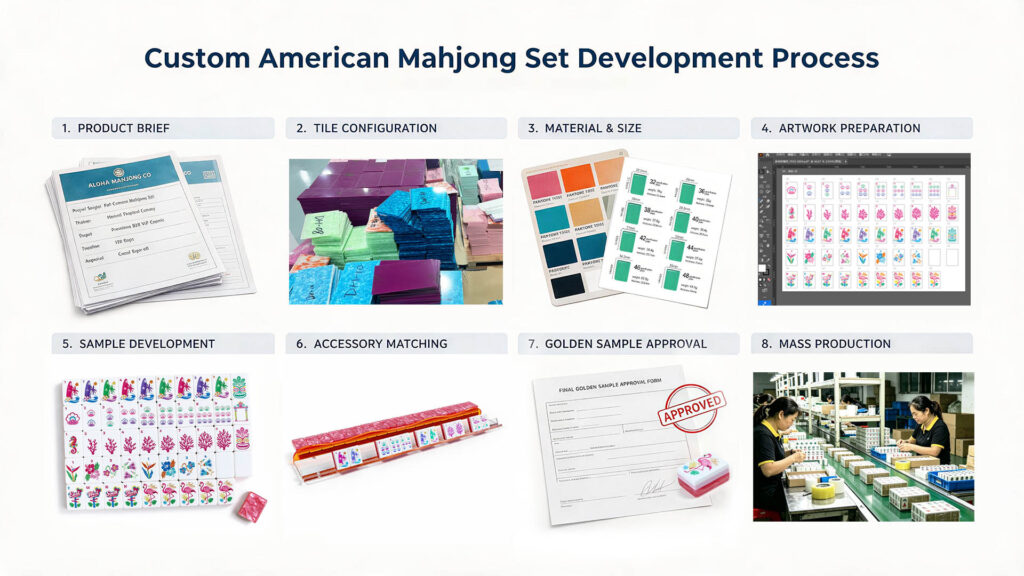
Step 1: Define the Target Customer and Sales Channel
The first step is not choosing a tile color. It is defining who will buy the product and where it will be sold.
A boutique retail collection may need a distinctive visual identity, coordinated accessories, and premium packaging. A set developed for Mahjong clubs may place more emphasis on durability, readability, replacement availability, and long-term reorder consistency.
An e-commerce product must also perform well in photography and survive parcel delivery. A gift-channel product may need a stronger unboxing experience, while a wholesale product may require more efficient packaging and a price structure that leaves room for retailer margins.
Before developing a custom American Mahjong set, clarify:
- Who is the intended player?
- Is the product positioned as entry-level, mid-range, or premium?
- Will it be sold through Amazon, Shopify, specialty stores, clubs, or distributors?
- Is the set intended for regular play, gifting, teaching, or collecting?
- What retail price is the brand targeting?
These decisions influence material, accessories, artwork, packaging, and order quantity. Without a clear market position, a set can become visually attractive but commercially difficult to price or sell.
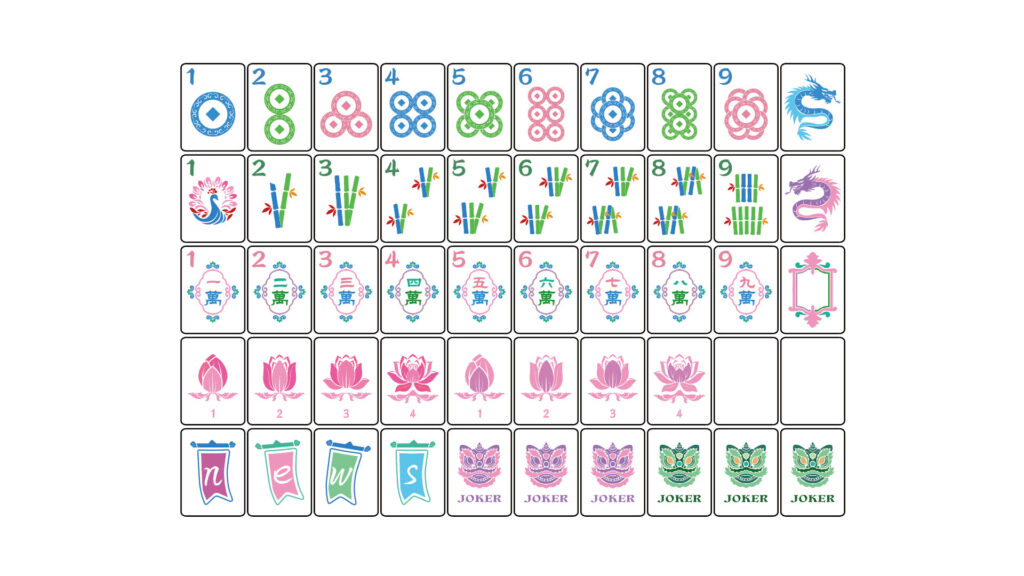
Step 2: Confirm the American Mahjong Tile Configuration
American Mahjong has a specific tile structure. A custom design still needs to remain practical and recognizable during gameplay.
The exact configuration may vary according to the brand’s product plan, but buyers should confirm the required quantities and categories before artwork preparation begins.
This may include:
- Dots
- Bams
- Craks
- Winds
- Dragons
- Flowers
- Jokers
- Blank or spare tiles
- Number markings
- Additional replacement tiles
One of the most common product development mistakes is treating the tiles only as a graphic design project. The artwork may look impressive as a presentation, but the finished set still needs to function correctly for American Mahjong.
Jokers and flowers provide more creative freedom, while suits and number markings usually require stronger consistency and readability. Brands should confirm the final tile list in a written document before sampling.
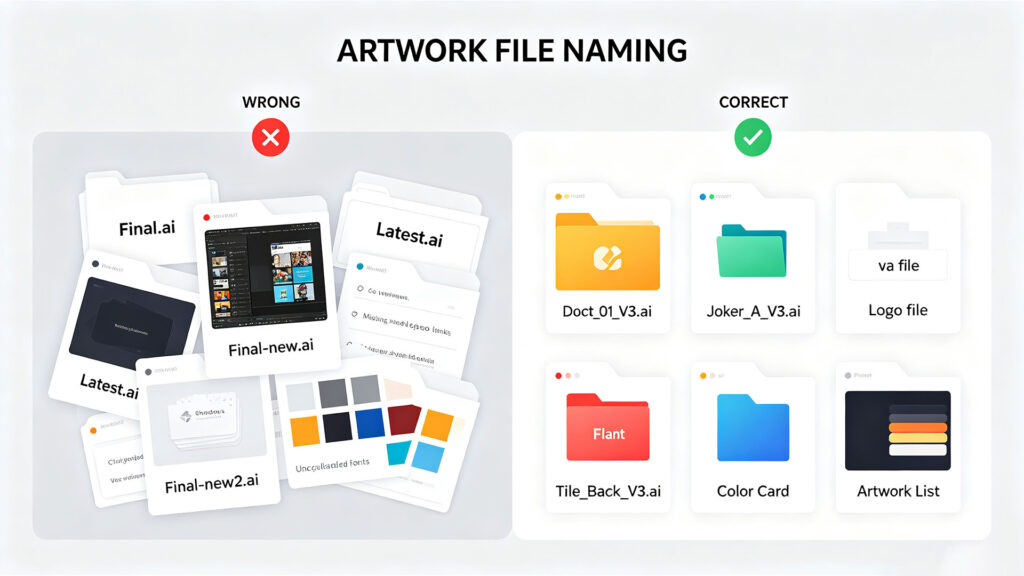
Every design file should also have a clear reference name. This reduces the risk of duplicated, missing, or incorrectly assigned tile faces.
Step 3: Select Tile Size, Thickness, Weight, and Material
Tile specifications influence nearly every other part of the set.
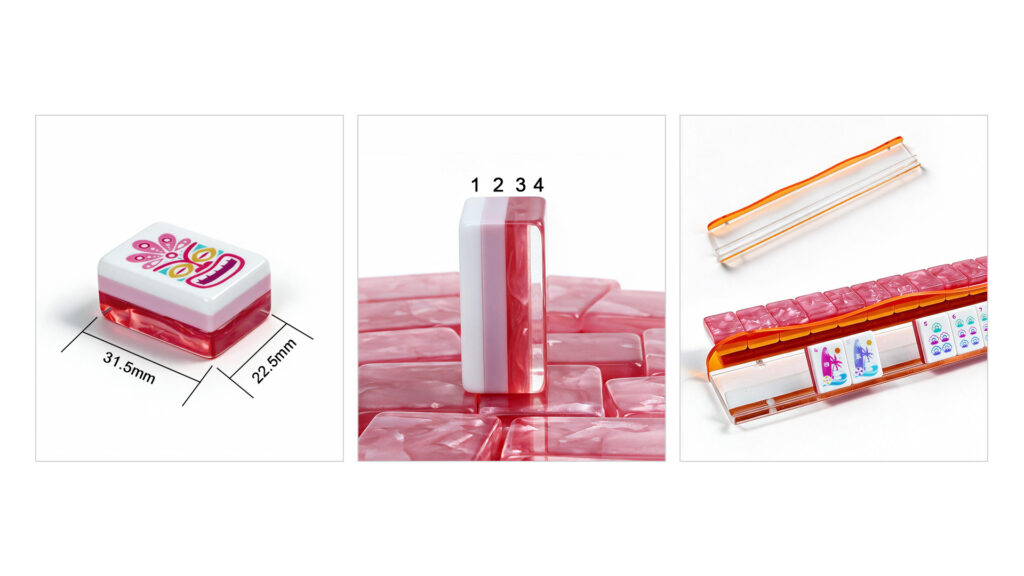
Larger tiles may create a more substantial hand feel and stronger visual presence, but they can increase weight, packaging size, and shipping cost. Thicker tiles may require wider rack slots, deeper box inserts, and larger carrying bags.
Brands should confirm:
- Tile length and width
- Overall thickness
- Target weight range
- Edge profile
- Corner shape
- Material type
- Number of acrylic layers
- Transparency or color effect
- Surface finish
Acrylic is commonly selected for design-driven American Mahjong products because it supports clear, translucent, colored, glitter, pearl-like, and multilayer visual effects. However, material selection should reflect the target market rather than follow appearance alone.
For example, a premium gift set may use a layered structure to create visual depth. A club-oriented set may prioritize readability, handling, and long-term consistency.
The final dimensions should be tested together with racks, pushers, bags, and packaging. A tile cannot be evaluated as an isolated component.
Step 4: Prepare Production-Ready Artwork
A rendered product image is helpful for communicating the overall concept, but it is usually not enough for production.
Manufacturers need clear artwork files for each tile face, tile back, logo, and packaging element. Vector formats are generally preferred because they allow the artwork to be scaled and adjusted without losing line quality.
A complete artwork package may include:
- Tile-face files
- Joker and flower designs
- Tile-back artwork
- Logo files
- Font references
- Color references
- Placement instructions
- Packaging graphics
- Instruction-card artwork
- Barcode files
Brands should also consider production limitations. Very thin lines may not reproduce clearly. Small text may become difficult to read. Subtle screen colors may look different when printed on a physical material.
A creative design should not lose its identity during production, but it must still be adapted for consistent manufacturing.
Step 5: Balance Creativity With Gameplay Readability
Custom American Mahjong tiles can be expressive, colorful, and highly recognizable as a branded collection. However, players still need to identify each tile quickly during real gameplay.
This is especially important for:
- Suit numbers
- Winds
- Dragons
- Jokers
- Flowers
- Similar-looking graphic elements
A tile can be visually creative and still remain practical. The goal is not to copy traditional artwork exactly, but to preserve enough visual hierarchy that players can understand the set without unnecessary effort.
During the sample review, brands should test the tiles from a normal playing distance rather than only examining close-up photographs.
They should also arrange full suits in sequence. This often reveals inconsistencies that are difficult to notice when checking individual artwork files.
Step 6: Match Racks, Pushers, Bags, and Accessories
A complete American Mahjong set should feel like one product rather than a collection of unrelated components.
Racks and pushers must match the tile dimensions. Bags must have enough capacity for the tiles and accessories without allowing excessive movement. Dice, mats, scorecards, and instruction cards should support the same visual identity.
Important compatibility questions include:
- Does the rack slot fit the tile thickness?
- Is the pusher length suitable for the rack?
- Can the bag hold the complete configuration?
- Are the colors consistent across tiles and accessories?
- Does the packaging protect each component?
- Can players remove and repack the set easily?
Accessory development also affects retail positioning. A simple tile-only product may suit one price segment, while a coordinated gift set with racks, pushers, a mat, and structured packaging may support a higher retail price.
TOPRAY can support the combined development of tiles, racks, pushers, bags, and packaging so that the complete set can be evaluated together during sampling.
Step 7: Develop Retail-Ready Packaging
Packaging should be designed around the final product configuration, not created independently before the tile and accessory specifications are confirmed.
A retail package may need to provide:
- Product protection
- Organized storage
- Shelf presentation
- Brand communication
- Shipping resistance
- Easy repacking
- Barcode placement
- Instruction-card storage
Common packaging options include gift boxes, carrying cases, rigid boxes, protective inserts, and simplified wholesale packaging.
The interior structure is especially important. If the insert is too loose, tiles may move and become scratched during transportation. If it is too tight, the customer may struggle to remove the components.
Brands selling online should consider both the retail box and the shipping carton. A visually attractive box may still require additional protection for parcel delivery.
Packaging development should also account for total set weight, accessory placement, outer-carton quantity, labeling, and warehouse handling.
Step 8: Review the First Sample as a Complete Product
The first sample is not only a color sample. It is the first opportunity to test whether the complete product concept works in practice.
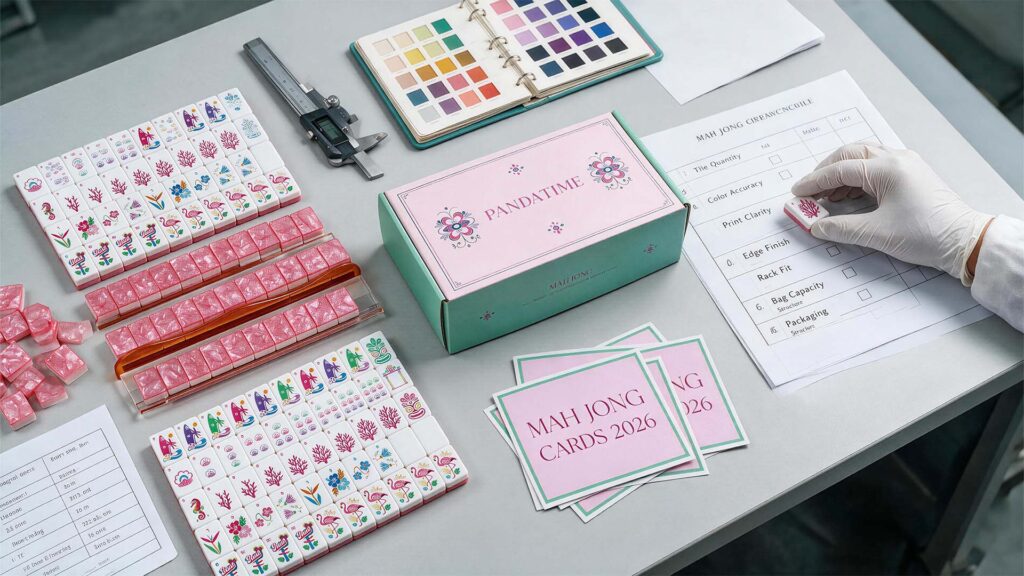
Brands should review:
- Tile quantity and assortment
- Tile dimensions
- Weight and hand feel
- Layer alignment
- Color accuracy
- Print clarity
- Symbol readability
- Edge polishing
- Surface condition
- Rack compatibility
- Pusher fit
- Bag capacity
- Packaging structure
- Unboxing experience
The sample should be handled, stacked, mixed, arranged on racks, packed, and unpacked. Product photography should also be tested because reflective or transparent acrylic may appear different under various lighting conditions.
Feedback should be specific. Instead of writing “the color is not right,” provide a reference, identify the affected component, and explain the preferred direction.
Clear sample feedback reduces unnecessary revisions and shortens the path to mass production.
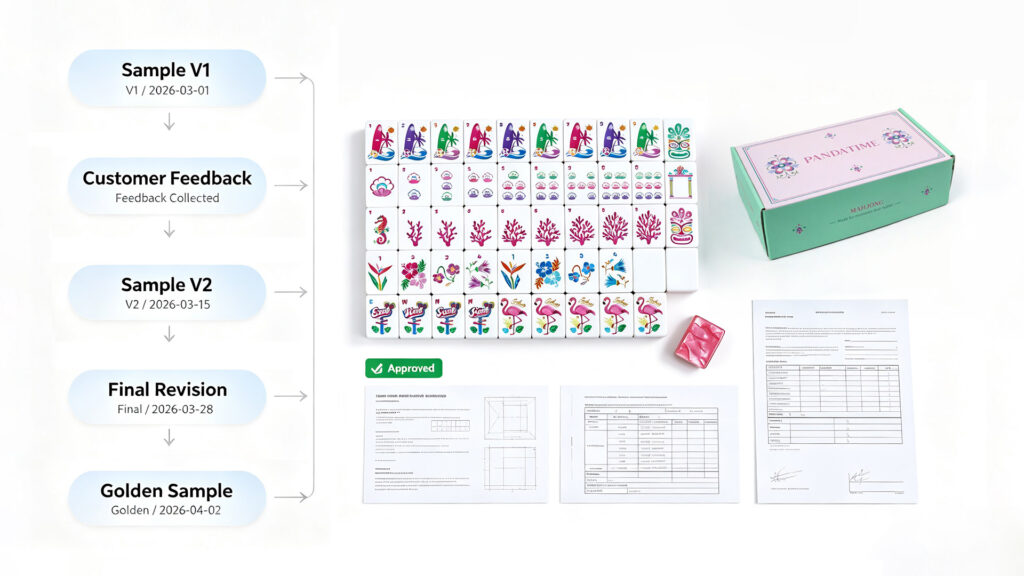
Step 9: Control Revisions and Approve a Golden Sample
Custom product development often requires more than one sample round. The process becomes difficult when feedback is delivered through scattered messages without clear version control.
Brands should collect internal comments before sending revision instructions to the manufacturer. Each round should have:
- A version number
- A dated feedback document
- Marked images
- Updated artwork files
- A list of approved items
- A list of required changes
Once the final sample is approved, it should become the golden sample or production reference.
The approved sample should represent the confirmed:
- Tile dimensions
- Color
- Artwork
- Layer structure
- Surface finish
- Accessories
- Packaging
- Labeling
Mass production should not begin while major design questions remain unresolved. Late changes can affect cost, lead time, materials, and production consistency.
Step 10: Plan MOQ, Lead Time, and Reorders
The minimum order quantity and development timeline depend on the level of customization.
A stock product with a customized logo may require less development than a completely new multilayer tile set with custom artwork, accessories, and packaging.
Factors that can influence MOQ and lead time include:
- Tile material
- Layer structure
- Number of custom colors
- Artwork complexity
- Accessory configuration
- Packaging type
- Order quantity
- Sample revisions
- Seasonal production capacity
Brands should plan backward from the intended launch date. The schedule should include artwork preparation, technical review, sampling, revisions, final approval, mass production, quality inspection, and shipping.
It is also useful to discuss reorder planning before the first order is completed. The manufacturer should know which materials, colors, and packaging components may need to be repeated in future batches.
Consistent specifications and retained artwork records can make future orders more efficient.
Common Mistakes Brands Make During Custom Development
Several avoidable mistakes can delay a custom Mahjong project:
Providing Only Renderings
Renderings communicate the concept but usually do not contain enough information for accurate production.
Designing Packaging Too Early
Packaging dimensions should be based on the approved tiles and accessories.
Ignoring Rack Compatibility
A small change in tile thickness may affect how the entire set works.
Prioritizing Decoration Over Readability
Creative artwork should still support practical American Mahjong play.
Reviewing Only Individual Tiles
The complete suit, full assortment, and finished set should be checked together.
Sending Uncontrolled Artwork Revisions
Poor file naming and scattered changes can cause outdated artwork to enter sampling or production.
Skipping the Final Approval Standard
Without a golden sample or written specification, it becomes harder to judge whether mass production matches expectations.
Underestimating the Development Timeline
Sampling, revision, packaging, production, and shipping all require planning.
What to Send a Manufacturer Before Requesting a Quote
Providing complete project information helps the manufacturer evaluate feasibility, cost, sampling requirements, and production planning more accurately.
Before requesting a quote, prepare:
- Target market
- Intended sales channel
- Product positioning
- Reference images
- Tile dimensions
- Material and color direction
- Tile configuration
- Artwork files
- Required accessories
- Packaging requirements
- Estimated order quantity
- Target launch date
- Sample requirements
- Expected retail price range
A quotation based only on a product image is likely to be incomplete. The more clearly the project is defined, the more accurately the manufacturer can assess the development path.
Final Thoughts
Developing a custom American Mahjong set requires coordination between design, gameplay, materials, accessories, packaging, quality standards, and production planning.
The strongest projects begin with a clear target customer and a realistic product brief. They use organized artwork files, confirm the American Mahjong tile configuration, test complete samples, and establish a final approval standard before mass production.
For brands, successful customization is not only about creating a unique appearance. It is about turning that appearance into a product that can be manufactured consistently, used comfortably, packed safely, and reordered reliably.
If you are planning a wholesale, private-label, or custom American Mahjong project, TOPRAY can help review tile specifications, artwork, acrylic structures, accessories, packaging, and sampling requirements before production. Share your product concept, reference images, estimated quantity, and launch plan to discuss a practical development solution.
Frequently Asked Questions
Can I Create My Own American Mahjong Tile Designs?
Yes. Brands can customize tile faces, jokers, flowers, backs, logos, colors, and visual themes. The artwork should be reviewed for readability and production feasibility before sampling.
What Artwork Files Are Needed for Custom Mahjong Tiles?
Vector files such as AI, EPS, or editable PDF files are generally preferred. Brands should also provide fonts, color references, logo files, artwork placement instructions, and a clear file list.
What Parts of an American Mahjong Set Can Be Customized?
Tiles, colors, layer structures, artwork, racks, pushers, bags, mats, dice, instruction cards, gift boxes, labels, and other packaging elements may be customized depending on the project.
How Long Does Custom Mahjong Set Development Take?
The timeline depends on artwork readiness, material selection, accessory development, packaging complexity, and the number of sample revisions. Projects should be planned backward from the intended launch date.
Can Custom Racks and Pushers Be Matched to the Tiles?
Yes. Racks and pushers can be developed or selected according to tile thickness, dimensions, color, and the overall product concept. Compatibility should be tested during sampling.
What Should Brands Approve Before Mass Production?
Brands should approve the tile assortment, dimensions, material, color, artwork, print quality, edge finish, accessories, packaging, labels, and final sample.
What Is the MOQ for a Custom American Mahjong Set?
MOQ depends on the level of customization, tile structure, artwork, accessories, packaging, and production requirements. Providing a complete project brief allows the manufacturer to evaluate the appropriate MOQ more accurately.